(13/1/05) UNISON today warned that shifting the responsibility for ensuring cleaner wards onto hard-pressed nurses and matrons will not cure the NHS of MRSA.
At a special UNISON breakfast symposium attended by government ministers, NHS professionals and trade unionists, general secretary Dave Prentis said the solution was to get more cleaners back on the wards to keep them clean, rather than relying on sanctions against contractors who fail to come up to scratch.
The union is stressing the important role of cleaning staff in infection control and cutting the number of hospital acquired infections, as part of its campaign for cleaner hospitals.
"Prevention is better than cure," said Prentis. "Handing contractors a 'report card' and taking sanctions against them for shoddy work is too late for all those patients who have already caught MRSA in a dirty ward.
"Nurses and matrons have enough on their plates caring for patients and dealing with the existing mound of paperwork – they don't have time to go round checking wards and toilets and ticking boxes on inspection sheets."
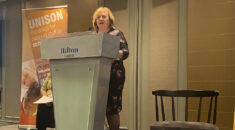
UNISON general secretary Dave Prentis addressing
the symposium [photo: Andrew Wiard/reportphotos.com]
He said that the government, the CBI and the Tories were "missing the point" by trying to shift the argument to being about good or bad cleaners, or about the merits of NHS cleaners versus out-sourced contractors.
"It is about having enough people to do the job well. Contracting out had led to a spiral of decline in the number of cleaners, full stop. John Reid has admitted that there is a link between the number of cleaners and the rate of infections in hospitals so why doesn't the government bite the bullet and get more cleaners back on the wards?
"Not only will it save a lot of people from heartbreak and suffering it will save the NHS money in the longer term."
Speakers included Polly Toynbee, columnist with The Guardian, who added that a "happy and skilled" workforce should be a priority but that's only possible if they are part of the "skills ladder" and receive a decent rate of pay.
Ann Robertson, a cleaner with more than 34 years experience, discredited the government's inspection regime, saying hospitals received advance notice of inspections, enabling managers to pull in staff from neighbouring wards for a mass clean-up.
Steve Davies, senior research fellow at Cardiff University, wrote an independent report for UNISON, Hospital contract cleaning and infection control. His view was that for 20 years hospital cleaning has been done "on the cheap"A in the UK, with cleaners "underpaid, understaffed and undervalued".
Around 100, 000 patients contract from hospital-acquired infections each year – 5,000 of whom. Such infections also cost the NHS more than £1bn each year, at a conservative estimate. Many patients will need continuing medical care as a result of contracting MRSA.
In response, Lord Norman Warner, parliamentary under secretary at the Department of Health, said the biggest surge in MRSA infections were in the Tory years of 1993-1997 when the disease became "endemic" in hospitals. But he "did not quibble" with UNISON figures that showed the size of the NHS cleaning staff to have almost halved in the last 15 years.
Hospital contract cleaning and infection control makes the link between infection control and hospital cleanliness. It backs up UNISON views that the contracting out process has led to falling standards of cleanliness in hospitals.
"Lets get back to basics," said Dave Prentis. "No one wants to be treated, work, or visit friends and relatives in a dirty hospital. There is no point in simply trying to tie contractors down to the detail of how cleaning should be done, or how the contract should be delivered. Staffing costs make up 90% of total costs and contractors will be looking at how they can cut costs and still make a profit.
"Bring cleaning staff back in house, make them part of the infection control team, give them proper training and then fairly reward them for a tough job that many people would run a mile from. That is the way to keep staff and inject a sense of pride and good morale into the job."
[L-R] Polly Toynbee (Guardian columnist), Niall Dickinson (chair, The King's Fund)
and Dave Prentis (UNISON) [photo: Andrew Wiard/reportphotos.com]
More on UNISON’s cleaner hospitals campaign